
Advisor’s journal - Stewardship in action
As an advisor, I’m responsible not only for the fundamentals of acquisitions and divestments, such as sourcing, market research, and price negotiations, but also for the peripheral, yet equally critical, considerations: framing, preservation, and conservation. These quieter decisions often have the greatest long-term impact on a work of art.
I recently assisted a client with the acquisition of a charming pastel drawing on paper by Pablo Picasso. With works on paper, age often brings visible condition issues—discoloration, foxing, creases, or the remnants of old mounting materials. In this case, the piece was remarkably fresh. The paper was in very good condition despite being nearly seventy years old.
One element, however, stood out: a prominent smudge near the upper center of the composition—almost certainly a fingerprint from some unknown moment in its history.
Was it Picasso’s own fingerprint? It's possible. But in my view, the mark distracted from the spirit and balance of the composition. Under magnification, the smudge appeared to rest primarily on the surface rather than being embedded in the paper fibers, and looked dry, not oily. There were a few lighter smudges near the upper right corner, around the date and signature, but those were far less intrusive. After thoughtful consideration, we chose a restrained approach: remove only the most visually disruptive blemish.
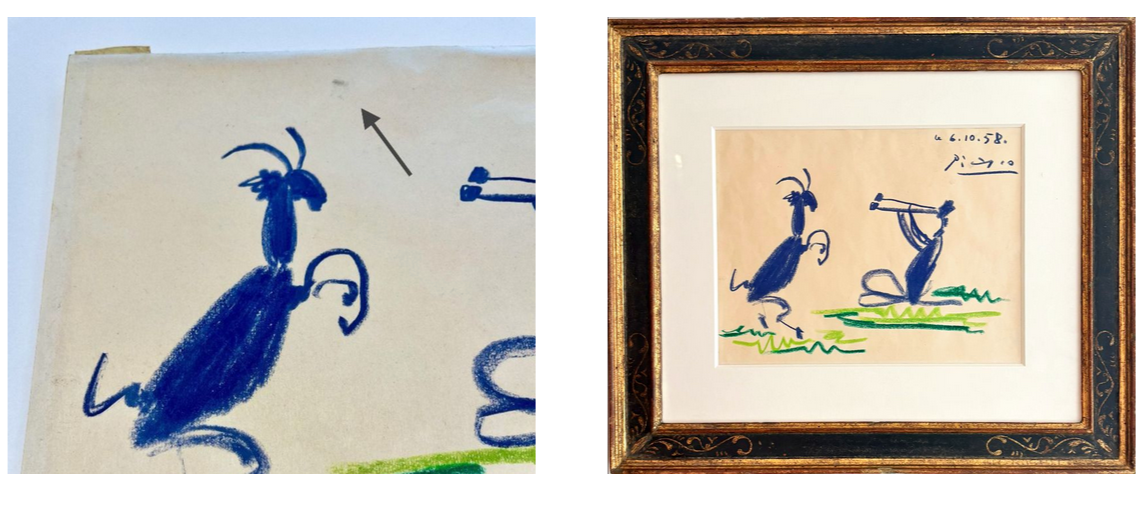
before (left) and after (right)
A professional conservator was able to remove the smudge beautifully, restoring clarity without compromising the integrity of the sheet. While the work was in the studio, the conservator also removed old tape from the reverse. Fortunately, it had not caused damage, but it was neither archival nor necessary. Its removal was straightforward and risk-free.
We then turned to presentation. We preserved what we believe to be the original wood frame, but replaced an aging mat with a an archival one and added UV-protective, museum-quality glazing to safeguard the pastel from light exposure. These subtle updates will help ensure the drawing’s stability for decades to come.
The results were outstanding—visually refined, structurally sound, and fully respectful of the artist’s hand.
A Few Rules of Thumb for Conservation
Do as little as possible.
If a new medium is introduced, ensure the process is reversible.
Keep thorough records of any treatment.
Work only with vetted professionals, such as members of the American Institute for Conservation.
Aim to prepare the piece thoughtfully for its journey into the future.
It’s a pleasure to be involved with significant works of art. Each piece carries history, intention, and cultural value far beyond any single owner. At the same time, that pleasure comes with responsibility. As advisors and collectors, we are not merely caretakers for today—we are stewards for the next generation.